8 stars

21 Grams

dir: Alejandro Gonzalez Inarritu
[img_assist|nid=1037|title=Let's overact together, shall we?|desc=|link=none|align=right|width=449|height=406]
Poetically, romantically, the human soul is said to weigh 21 grams. This is based on experiments inaccurately carried out long ago which claimed that upon death a person would instantly lose 21 grams of weight, thus the departure of the soul must be responsible for the change. Of course it has no basis in reality. But the central question still remains: whether the body loses 21 grams or not upon death, how much do we lose when those we love die? How much do they lose when we die? When we take a life, save a life, how much is gained? How much is lost? This film seems to indicate that at the very least it's something more than 21 grams.

Director Alejandro Gonzalez Innaritu is two for two. After his most excellent debut with Amores Perros, along with writing partner Guillermo Arriaga he again delivers a compelling, emotional and thoughtful film which packs an emotional punch without resorting to cheap tricks or manipulation. Whilst most will focus on the disjointed chronology with which the story is portrayed through the complicated editing, at its core the film deals with powerful moments in these character's lives which rarely if ever overstep the bounds of genuine drama into kitchen-sink melodrama. The film achieves pathos without bathos, which is a glib way of saying that it's a damn fine film.

Rating: 

Adaptation

Adaptation

Some days it's hard not to feel exactly like that

dir: Spike Jonze

2002

This is one of the best films from last year that practically no-one is going to bother seeing, I can just feel it. It probably has one of the least marketable premises of any film I can think of in recent memory, and doesn't exactly scream 'rollercoaster ride of thrills and spills' for your $13.50

It is still in my anything but humble opinion one of the best films of 2002, and Nicolas Cage manages to surprise me heartily by delivering two sterling performances, when I expected nothing from the man. Nothing at all. His last bunch of films have been dogs, so I had begun mourning the talent that Cage used to possess. And what does the fucker do? He delivers his best performance in over a decade.

Rating: 

Quiet American. The

dir: Philip Noyce
[img_assist|nid=1044|title=I wonder how that war ended up going...|desc=|link=none|align=right|width=319|height=475]
Wait, there was a war in Vietnam? Why didn't anyone tell me about it? Was it a big war? And why has Hollywood ignored this potential goldmine? They should get that room with the thousand monkeys chained to their typewriters cracking right away.

I am sick to death of films relating to the Vietnam war. Thoroughly sick to fucking death. Sure, there's been plenty of wonderful and touching films about America's obsession with that little communist country (Full Metal Jacket, Deer Hunter, Apocalypse Now, Platoon, Hamburger Hill) and the apparent deep scar it has left on the national psyche, but I think it's been done more than enough. Give it a rest, people. Hell, I love a good war film as much as the next sociopath, but there's this point where a dead horse has been whipped so much that you haven't even got enough horse left to make gravy with.

In that case am I glad that this film, though it deals again with that country, is focused upon the lead up to
the 'war' as opposed to the war itself? Well, kinda.

Rating: 

Ghost World

dir: Terry Zwigoff
[img_assist|nid=1032|title=She broke a million nerd hearts with this role|desc=|link=none|align=right|width=400|height=300]
Movies tend to celebrate the triumph of the individual. The underdog beats the less-likeable and usually wealthy favourite to win the adulation of the crowd. Villains get their comeuppance at movie's end, with the hero finally getting the girl and the acknowledgment that they deserve, usually with a large television audience watching in masturbatory glee.

We as people want to associate ourselves with winners, with success, with victory. We can relate to the personal hardships that the film protagonists go through, as we all have mishaps, accidents and fuckups in our lives, just probably not on the same scale. And when they (usually) inevitably triumph over the odds to win the belt, the cup or kill the bad guy, we feel that associative rush as well, sharing in their triumph. We're winners as well. Our value systems, whilst certainly not uniform around the globe, tend to prize success, coolness, triumph in competition against others, the overcoming of obstacles, prejudices etc to achieve what we all ultimately want: acceptance and approval by society and those around us.

Rating: 

Mulholland Drive

Mulholland Dr

nothing will ever be okay ever again

dir: David Lynch

2001

A few minutes after watching the film, I found myself at a pub which just happened to be conveniently located around the corner from the cinema. I wasn't sure how I'd gotten there, nor what I was planning on doing once I was there. I sat at the bar, confused and wondering.

One of the girls working behind the bar must have come towards me to ask what I wanted to drink, but I must not have heard her at first, because when I realised where I was, she was shaking me by the shoulder, concerned with the current location of my mind and presumably my wallet.
"Eh, are you okay?"
- "I'm not sure."
"What's happened to you, were you beaten up?"
I felt around my face and body "No."
"Were you in a car accident?"
Again, I answered in the negative. "Do I look that bad?"
"Well, you look like you just found out your mother just died. Ah, wait, I've worked it out now."
She walked away from me, poured a double shot of some stiff drink into a glass, and handed it to me.
"On the house."
- "Th-- Thankyou. Why?"
"You'll need it. You just watched the latest David Lynch film, didn't you?"
- "Yes, yes I did. How could you tell?"
"We get that a lot around here." She waved her hand in a broad arc, encompassing many of the other people sitting around the pub. Many of them had the same shellshocked, post traumatic stress disorder facial expression that I must have had plastered all over my face.

Rating: 

Way of the Gun, The

The Way of the Gun

The way of all things in the States is gun-related

dir: Christopher McQuarrie

2000

The Hollywood variation on the American Dream, which is the regular American Dream anyway, is that a screenwriter, actor or director previously subsisting on tips from being waiters and valets to the bourgeoisie can get the big break and become another star in the firmament. Glowing bright, suspended above the masses; all they need is that one big break.

The problem is, there are no guarantees in this or any other life. The big break can just as easily catapult you back into obscurity after you crash and burn.

Christopher McQuarrie’s claim to fame was that he scripted The Usual Suspects, which propelled director Bryan Singer into the stratosphere, got Kevin Spacey an Oscar for his role as Verbal Kint, and gave audiences one of their favourite overly convoluted crime movies of 1995. It also garnered an Oscar for McQuarrie as well. But then again, who really gives a good goddamn about Oscars in general and Oscars for Best Original Screenplay anyway. I bet you don’t, don’t pretend otherwise, I won’t believe you.

Someone must have thought McQuarrie deserved to get paid as well, so despite having no experience as a director, he was given the money and the freedom to try to repeat the magic of Suspects. Did it work?

Well, ask yourself: Have I heard of Way of the Gun? If you never saw it at the cinema, and never saw it on DVD, tv or cable, and in fact never heard of it until you saw this review, then it probably wasn’t as successful as Suspects, to put it mildly.

I saw this in the cinema oh so long ago. I was the only one in the theatre, and I seem to recall the movie disappeared from the cinemas the same week (when it opened) I saw it. In fact, the ticket I purchased to watch it, any posters or references to the flicks also disappeared, and the staff in the cinema pretended the movie never existed…

Perhaps not, but let’s just say that the film was a bit of a box office failure, which is why the film routinely languishes in the discount bargain bins at the joint where I buy DVDs from. After having thought about picking it up and rejecting the idea at least a thousand times, last week I relented, and thus a review has been expelled, extruded and expectorated from my brain through the fingers to this hallowed website. So, you know, enjoy.

The Way of the Gun is a really, really good crime flick. It deliberately approximates a 70s aesthetic and mindset, and conducts itself with absolute seriousness. It tries to be anything but disposable. It tries to be memorable at every stage. It approaches the world of the professional criminal with respect but wariness: these people may be rational and logical agents, but they are absolutely ruthless, and capable of much in the service of their ambitions.

Rating: 

Unbreakable

Unbreakable

yeah nah everyone and anyone is pretty much breakable

dir: M. Night Shyamalan

2000

You don't need a ouija board, an on-line fortune teller or one of Dionne Warwick's Psychic Friends at five dollars a minute on the phone to tell you that this film has ""stinker"" written all over it in twelve-foot dayglo letters. It's put out by Disney, the director is following up the commercial ""Working girl at a Liberal Party conference"" financial success of his first film, The Sixth Sense, and it has Bruce Willis in it yet again. And, not that it matters, but one acquainted with the net could not ignore the sheer abundance of middling to mediocre reviews this film has garnered. And the last factor not in its favour is the implication that the film had something to do with comic books. Nothing gives off that sphincter loosening aroma of failure like the words: "Based on the comic book/graphic novel", or "In The Tradition Of", or "I'm sorry, I must have had too much to drink."

With none of this in mind, I ventured forth into the Greater Union cinema, still seeing no indication of anything that Great or Unionised about the place. The audience was full of your usual cud-chewing, mobile-phone-ringing, talking during the quiet bits fuckknuckles that we've all come to know and love. After a stream
of increasingly meaningless and indecipherable trailers, I lay back and prepared myself either to be dazzled or for a restive, comfortable nap.

Let's look at the elements included herein:

Nothing turns up a film snob's nose up quicker than a film that achieves extraordinary box office success. The Sixth Sense was a money juggernaut last year, and many people were ejaculating all over the place about it, for better or worse. For many, expectation was very high for his (Shyamalan's) sophomore effort. I thought 6th Sense was a tremendous film, even watching it knowing what the twist was well before hand, I thoroughly enjoyed it. Willis was restrained, the kid was magnificent and spooky without being reclaimed as cutesy, and it was wonderfully filmed and put together. Colour me a fan of my man Shyamalan.

Bruce Willis is a film enigma. For every Pulp Fiction, 12 Monkeys and Die Hard he's been in, there's Armageddon, Colour of Night and Die Hard 4: My Colostomy Bag Has Ruptured. He has a capacity for being tremendous in film roles, he just needs to be reminded by the director every few minutes or so that he was married to Demi Moore for many years, thus bringing him back to earth and making him feel humble again.

Rating: 

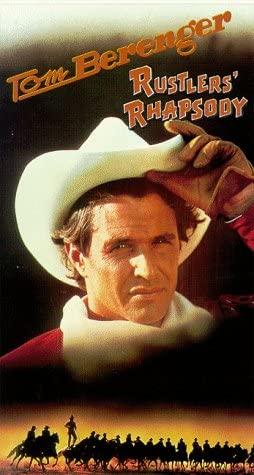
Rustlers' Rhapsody

Rustler's Rhapsody

He maybe the hero, but he's not going to be a jerk about it

dir: Hugh Wilson

Charming movie with Tom Berenger. An affectionate spoof on those black and white singing cowboy movies, seen through today’s eyes. Starts in black and white. Very well done; top movie and excellent cast including Fernando Ray who was in all of Bunuel’s movies, and Andy Griffiths as the Colonel. A young Sela Ward (Wife/doctor in The Day After Tomorrow) plays the Colonel’s daughter.

Rating: 

Ikiru

To Live

Old man take a look at my life, it's nothing like yours

dir: Akira Kurosawa

1952

An aged bureaucrat, entrenched in the job for thirty years, finds out he is dying. The pointless busy work he has juggled for the length of his career, the professional objective to help no-one and do nothing unless it falls within the narrow parameters of the job description, now no longer seems as wonderful a task as it used to.

He wonders what to do now that he no longer has uncertainty regarding his fate. He takes out some of the money he’s been squirreling away, to see what he’s been depriving himself of for so long. He doesn’t tell his annoying, selfish son what’s going on, since he’s a greedy and overbearing prat, and the son’s wife is a bit of a bitch as well.

He tries the whole ‘drinking and bitches’ routine, but finds he ultimately has no taste for either. He laments his wasted life, and the manner in which he has been more dead than alive since his wife’s death many decades ago. It hurts him that his son doesn’t love him as much as he loves his son, choosing not to remarry upon his wife’s death (when the son is still tiny) for the son’s benefit. Now all the son and his wife can do is berate the old man and pray for his death so they can get a hold of his money.

The film sounds like a laugh a minute, I know, but there’s more going on in the film than it trying to get you to slit your wrists. It does have a mournful tone in parts, elegiac throughout, but there is, in the end, a redemption of sorts for our hero, who’s anything but, really.

Watanabe (Takashi Shimura) is, until his diagnosis, the quintessential bureaucrat, surrounded by fortifications of paperwork, unhelpful to any that approach, only mindful of safeguarding his job and determined never to help the people who ask for his help. The irony is, of course, that he works for a division of local government called Public Affairs, which means his job is meant to be helping people living within his prefecture.

Helping people, of course, doesn’t interest him. As a recurrent element throughout the film, a group of poor women keep trying to get the bureaucrats to help them with a serious problem in their slum, but every desk sends them to a different desk so that the women, after traversing every room and floor in a large building, end up right back where they started.

Ah, the exquisite pointlessness and inefficiency of bureaucracy! You can only really appreciate the nuances of something like this if you’ve worked for the Beast directly. Sitting, as you would in the Beast’s belly, you’d know the peculiar feeling that eventually envelops all bureaucrats and renders them ineffectual as human beings. It’s this unwillingness to do anything, this resistance to helping people, and an Olympian disdain for other lowly humans which produces characters like the ones in this film.

Rating: 

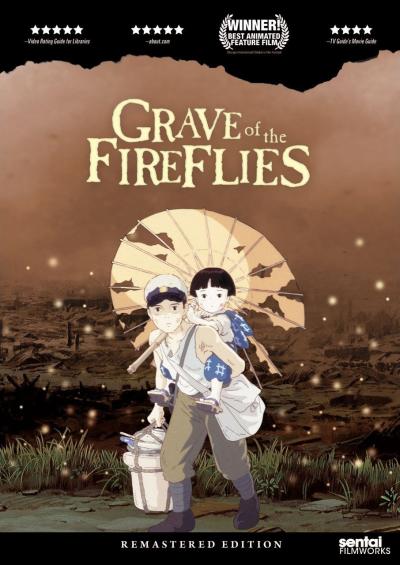
Grave of the Fireflies

Grave of the Fireflies

Just looking at this image makes me tear up

dir: Isao Takahata

1988

For all the pop culture popularity of Japanese animation, it still has a pervasively negative reputation. The main reason for this being, of course, the relatively small percentage-wise amount of anime that seems to be exclusively created for the purpose of creating violent stroke material. Anyone confused as to what I mean by ‘stroke material’ should know that I’m not referring to people having aneurysms or lapsing into comas.

In the same way that it would be inaccurate to say that all French cinema is basically films like Irreversible or Baise Moi, it’s unfair to tar Japanese animation with the hentai / giant robots / tentacle / schoolgirls brush. Sure they play a part, but much of it is just about telling a story.

Grave of the Fireflies is a heartbreaking entry in the genre, which has nothing to do with science fiction or girls having their underwear stolen by demons. It is a simple story (on the surface) about a brother and sister trying to survive in Japan during World War II. It has recently been given the royal treatment on DVD (Madman), which is why I felt inspired to write about it now, having just purchased it. The two disk set certainly is worth the purchase price for the film alone, but contains a plethora of worthwhile extras that sweeten the deal even more.

For a film of such beauty in which nothing much happens apart from the long, idyllic march to the grave, the makers have transcended the basic elements that constitute our expectations (at least mine as a non-Japanese viewer) of animation and crafted a story no less poignant or evocative than any live action film. Constructed with an incredible amount of craft, each panel seems to have been lovingly painted by people who had an infinite amount of time on their hands, which is obviously not the case.

Put together by the famous Studio Ghibli (directed by Isao Takahata, and not the ‘master’ Hayao Miyazaki) it exemplifies all the trademarks of that studio’s work which, bizarrely enough achieves everything Disney wishes it still could but never will again: great looking animated features that tell great stories and are massively, commercially successful. The irony of course being that Miyazaki created the studio having been inspired by the earlier works of the Mouse House in no small part.

Rating: 

Pages